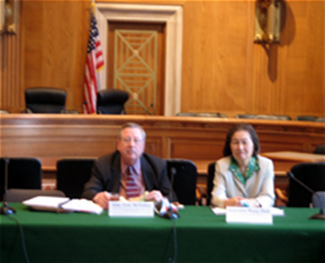
"China's Security Interests"
Admiral Eric McVadon
June 20, 2008
During his June 20 seminar, Admiral McVadon discussed some of the key issues raised by Chinese defense and military modernization, including developments in the North Korea nuclear situation and cross-Strait relations.
Regarding the North Korea issue, Adm. McVadon suggested China’s role has fostered good bilateral relations, altered the security environment – including rather than excluding China – and enhanced prospects of an inclusive security framework. Adm. McVadon cautioned the Six Party Talks remain difficult, with the outcome uncertain. He suggested this issue is wider than just the nuclear controversy, explaining even if the Six Party Talks fail, they have acted as a springboard to new regional security arrangements and have brought about a greatly improved U.S.-China relationship that could develop into a new paradigm for cooperating.
In addressing developments in the Taiwan issue, Adm. McVadon outlined the current Sino-Taiwan-U.S. relationship and explained some of the implications Chinese security developments have on this volatile issue.Currently, McVadon observed China’s military intimidation and political maneuvering have kept Taiwan from moving toward independence and exacerbated polarization of Taiwan’s people. He believes Chinese military modernization over the last decade has been designed to defeat Taiwan quickly and thwart timely, effective U.S. intervention. McVadon briefly described the “new PLA” and its astute choice of ballistic and cruise missiles (second artillery) – weapons that are very hard to counter and that minimize direct risk to the PLA ground, naval, and air forces.
Admiral McVadon outlined the relationships and connections currently in place between China and the United States; these include various alliances, communiqués, and statements, both clear and ambiguous. The degree of communication suggests the United States and China have moved from previously provocative, almost adversarial relations to what is arguably a budding strategic partnership. Examples of these steps toward partnership include a cession of using inflammatory labels to refer to the other; a new military hot line; good personal relations between the presidents, foreign minister and secretary of state; exchange of visits by senior officials and military officers; and the effort to resolve the North Korean nuclear issue.Looking to the future of U.S.-China relations, Adm. McVadon recommended a policy of “engaging seriously, hedging seriously.” He also suggested the role the United States chooses to play in the evolution of the security environment and the formal security architecture the Chinese defenses take will have significant implications for Sino-U.S. relations.
Profile of Admiral McVadon
Lecture notes (PDF)
Links to additional Policymakers pages:
Return to Lectures Page
Policymakers Program Home
2008 Program Overview
2007 Program Summary
Policymakers Program Group Photos
Policymakers Program Photo ArchiveIf you have any questions about this lecture series, please contact the foundation at uscpf@uscpf.org